

Operational Control in Multi-Entity Businesses: How to Scale Without Losing Visibility
BUSINESSCORPORATE SERVICESENTITY MANAGEMENTADVISORYLEGAL
Subscribe to our blog to receive expert insights straight to your inbox.
As companies expand across jurisdictions, complexity increases faster than most teams anticipate.
New entities are formed.
Operations spread across countries.
Compliance requirements multiply.
Individually, each component is manageable. Collectively, they create a common problem: Loss of operational control.
This doesn’t happen because of a single failure. It happens gradually — through fragmented systems, disconnected processes, and lack of centralized visibility.
For growing businesses, the real challenge is not expansion. It is maintaining control while scaling.
What Is Operational Control in a Multi-Entity Structure?
Operational control refers to a company’s ability to:
maintain visibility across all entities
track compliance obligations and deadlines
manage legal, financial, and administrative processes consistently
ensure alignment between strategy and execution
In a multi-entity environment, this becomes significantly more complex due to:
multiple jurisdictions with different regulatory frameworks
varying compliance timelines and filing requirements
decentralized teams managing different functions
fragmented data across systems and providers
Without a structured approach, companies begin to lose clarity over how their organization actually operates.
Why Companies Lose Control as They Scale
Most companies do not plan for operational complexity early enough.
As a result, they rely on:
spreadsheets for compliance tracking
local advisors operating independently
disconnected legal, accounting, and HR processes
reactive decision-making instead of structured oversight
This leads to common issues such as:
missed filing deadlines
inconsistent governance practices
lack of real-time visibility across entities
delays in decision-making
increased regulatory and financial risk
Over time, these inefficiencies compound — especially during audits, fundraising, or expansion into new markets.
The Three Layers of Operational Control
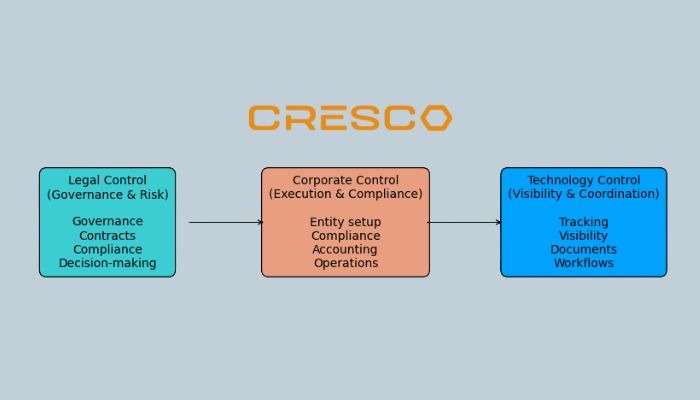
Maintaining control across a multi-entity structure requires alignment across three core layers:
1. Legal Control (Governance & Risk Management)
Legal frameworks define how decisions are made and how risk is managed.
This includes:
corporate governance structures
contract management and risk allocation
regulatory compliance
decision-making authority and documentation
Without consistent legal oversight, companies face:
unclear accountability
contract inconsistencies
exposure to regulatory risk
A structured legal approach ensures that governance aligns with how the business actually operates.
2. Corporate Control (Execution & Compliance)
Corporate operations are where strategy is executed.
This includes:
company formation and structuring
annual compliance and statutory filings
accounting and treasury management
corporate secretarial and record-keeping
The challenge is not just execution — it is coordination across jurisdictions. Without centralized management, companies often experience:
duplicated efforts
inconsistent reporting
gaps in compliance
operational inefficiencies
Corporate control ensures that all entities remain compliant, aligned, and operationally consistent.
3. Technology Control (Visibility & Coordination)
Technology provides the layer that connects everything. A centralized system allows companies to:
track compliance obligations in real time
manage documents across entities
maintain visibility over deadlines and requirements
coordinate execution across teams and providers
Without technology, companies rely on manual processes that are difficult to scale. With the right system in place, they gain:
real-time visibility
improved coordination
faster execution
reduced risk of oversight
How to Maintain Control While Scaling
To maintain operational control, companies should focus on:
Centralization: Bring legal, corporate, and operational data into a unified structure.
Standardization: Create consistent processes across entities and jurisdictions.
Visibility: Ensure leadership has real-time insight into compliance, operations, and risk.
Coordination: Align internal teams and external providers under a single framework.
Operational Control as a Competitive Advantage
Companies that maintain control as they scale are able to:
expand into new markets faster
respond to regulatory changes more efficiently
improve financial and operational performance
reduce risk during transactions and audits
In contrast, companies without control often slow down as complexity increases.
How Cresco Supports Multi-Entity Operations
Cresco provides an integrated approach to operational control across three pillars:
Cresco Counsel (Legal Services)
U.S.-based legal support for governance, contracts, and risk managementCresco Business Services (Corporate Execution)
Entity setup, compliance, accounting, and administrative operations across jurisdictionsCresco Tech Services (Entity Management System)
AI-driven platform providing centralized visibility and coordination across entities
This combined approach allows companies to scale while maintaining structure, visibility, and control.
Conclusion: Control Enables Scalable Growth
Growth introduces complexity. Without structure, that complexity turns into fragmentation — across entities, teams, and jurisdictions.
Operational control is what keeps expansion aligned, visible, and executable. Companies that get this right don’t just grow faster — they operate with clarity, make better decisions, and reduce risk across every layer of the business.
Cresco brings together legal, corporate, and technology capabilities to support multi-entity operations with structure and oversight.
Explore how Cresco can support your global operations:
https://cresco-global.com
Or contact us directly:
contact@cresco-global.com
Related Content
Business services and subscription legal counsel, supported by a structured entity management system for compliant global operations.
All Rights Reserved. © 2026
Terms & Conditions
Privacy policy


Our Solutions
Home
About Us
Contact Us
Contact Info
1221 Brickell Avenue
Miami, FL 33131
contact@cresco-global.com
Attorney Advertising. Prior results do not guarantee a similar outcome.
Read Full Disclaimer Here.


GET IN TOUCH
Our Company